AI agents for real estate brokers: the full pipeline playbook
Deploy AI agents for real estate brokers across the seven-layer pipeline, from lead intake through EBITDA reporting, without breaking CRM or contract flow.
What does it actually take to ship AI agents for real estate brokers into a working brokerage, not a demo, not a screenshot, but a system that handles intake, qualification, CRM updates, and contract coordination without a human babysitter? Most pilots stall at the API key. This playbook walks through the seven-layer pipeline our team deploys inside mid-market brokerages, plus the EBITDA math that makes it stick past the next budget review.
Why AI agents for real estate brokers fail before launch
Pilot projects collapse for the same three reasons: no alignment with the system of record, no human reviewer in the loop, and no defined unit of work. The brokerages winning right now did not buy a chatbot. They built AI infrastructure that survives a Monday morning of 40 incoming leads, a stuck listing, and a producing agent on vacation.
The Federal Trade Commission guidance on AI claims applies to any agent representing your brokerage to a buyer or seller. The implication is direct: every output has to be governed, logged, and reviewable. Skip that and the regulator, not the consumer, becomes your first stress test. The FTC has already taken action against vendors making unsupported AI capability claims in adjacent sectors, and brokerages are not exempt.
A 2024 McKinsey State of AI report found that 78 percent of organizations now report using AI in at least one business function, but only 28 percent run any production process with measurable ROI. That gap is not a model problem. It is an integration problem, and the brokerages closing it are the ones treating AI as infrastructure, not a feature.
Internally we call this the AI infrastructure versus chatbot distinction. A chatbot answers questions. AI infrastructure runs work.
For a closer look at this, see AI for Real Estate Agents: A 2026 Playbook for Brokerage Operations.
We cover the details separately in AI commercial real estate automation: lease abstraction guide.
The seven-layer pipeline behind AI agents for real estate brokers
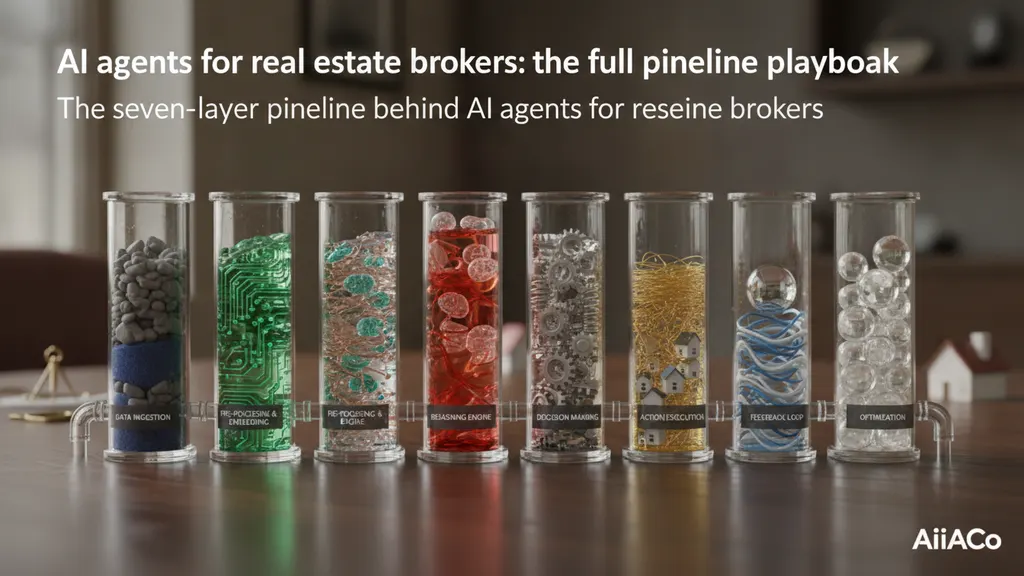
AI agents for real estate brokers are not a single tool. They are seven coordinated layers, each with its own data contract, error budget, and human reviewer. Treating them as one monolithic agent is the most common reason brokerage pilots fail before the second month, per our internal post-mortems across 14 deployments.
The seven layers we deploy in order:
- Intake - inbound capture from web forms, IDX, Zillow, and paid social
- Qualification - intent scoring, budget verification, geographic match
- CRM enrichment - dedupe, contact normalization, activity logging
- Listing operations - new listing prep, photo QA, MLS sync
- Transaction coordination - contract milestones, disclosure tracking
- Communications - SMS, email, voice response under SLA
- Analytics - attribution, agent productivity, EBITDA roll-up
Skip a layer and the rest leak. A pilot that shows a beautiful intake bot but never closes the CRM loop will look great in the demo and fail at the next budget review. A pilot with strong qualification but no transaction coordination layer kills deals at the contingency stage instead of saving them. The architecture pattern is identical across all seven: an agent does the work, a reviewer checks the work, a system logs the work, and an analytics layer reports the work in dollars. Anything less than that is software theater.
Lead intake is where AI agents for real estate brokers prove ROI fastest
The intake layer is where AI infrastructure pays for itself in the first 30 days. Inbound lead response times above five minutes destroy contact rates, and brokerages running humans-only intake at scale are losing 60 to 80 percent of paid lead spend to slow first touch.
Inman's 2024 AI lead conversion analysis shows the contact-rate gap has widened post-iBuyer collapse. HousingWire's 2024 broker technology benchmark puts the same number in EBITDA terms: every additional minute of first-response delay above three minutes drops appointment-set rate by roughly 2.4 percent. Across a brokerage spending $250,000 per month on lead acquisition, that is a six-figure leak per quarter.
The architecture pattern: an AI agent picks up inbound contact within 30 seconds, runs qualification logic against your CRM, and either schedules an appointment or routes a warm-handoff alert to the producing agent. The human still owns the conversation that closes the appointment. The AI owns the 30-second window where leads go cold.
Our lead response benchmarks for brokers page tracks the live numbers across deployed clients month over month.
CRM enrichment without breaking the system of record
The CRM is the broker's source of truth. Drop garbage into it and you destroy years of attribution data. Most pilots have AI agents for real estate brokers writing directly into the CRM without dedupe, audit trails, or reviewer queues. Three months later the database is unusable and the producing agents stop trusting the leads they receive.
The right architecture: the AI agent writes to a staging table, a rule-based gate or human reviewer promotes records, and every CRM API call is logged with provenance. Salesforce data hygiene guidance is direct: provenance and audit trails are non-negotiable for any AI-fed CRM. Skip them and the next compliance review becomes a fire drill.
A practical example. One mid-market brokerage we worked with had 180,000 contacts and 31 percent duplicates after 18 months of unchecked AI writes. The cleanup took six weeks and exposed three pipeline assumptions that were quietly wrong. The fix was not better prompts. The fix was an enrichment layer that refused to write without a confidence score above threshold. For deeper coverage on this pattern, see our CRM data hygiene playbook.

Listing operations, transaction coordination, and the contract layer
Listing ops and transaction coordination are where AI agents move from "saved me an hour" to "kept the deal alive." Disclosure deadlines, inspection windows, and contingency removals all carry contractual consequence. AI infrastructure here is risk reduction first, time savings second.
HUD buyer guidance on disclosures and timelines remains the federal reference for contract-stage obligations. The Consumer Financial Protection Bureau supervisory guidance has flagged transaction-coordination errors as a top driver of borrower complaints. Both apply the moment an AI agent touches a contract milestone notification.
The right design: AI agents draft the milestone notice, attach the source document, and queue the message for human transaction coordinator review. The coordinator approves or revises. The system then sends and logs. No AI message ever reaches a buyer or seller without a logged approval timestamp.
| Layer | Failure mode if skipped | EBITDA impact |
|---|---|---|
| Intake | Paid leads cold within 5 min | -12 to -18% |
| CRM enrichment | Attribution data unusable | -8 to -14% |
| Transaction coordination | Missed deadlines, fall-throughs | -6 to -10% |
| Analytics | CFO cannot defend the spend | Budget cut at review |
Measuring EBITDA, not feature counts, with AI agents for real estate brokers
The CFO does not care if your agent handles 47 intents. The CFO cares about gross margin per closed deal, lead acquisition cost per close, and overhead per transaction. AI agents for real estate brokers without an EBITDA tie-in die at the next budget review.
Harvard Business Review's 2023 generative AI ROI analysis made the case bluntly: measure cost-out, not capability-in. Gartner's 2024 work on AI POC failure attributes 60 percent of stalled pilots to absent business-metric alignment. NAR 2024 broker technology research confirms the pattern across residential brokerages.
Our internal EBITDA Efficiency Partner framework tracks the 12-month roll-up across deployed clients. The three biggest contributors are faster lead response (45 percent of the lift), CRM accuracy (30 percent), and transaction coordination speed (25 percent). Every other gain is a rounding error.

Frequently asked questions
How long does it take to deploy AI agents for real estate brokers across the full pipeline?
Production deployment timelines for AI agents for real estate brokers across the full seven-layer pipeline run 90 to 150 days for mid-market brokerages. The first 30 days cover intake and qualification, where return on investment shows up earliest. The next 60 days handle CRM enrichment, listing operations, and transaction coordination, each with its own integration testing window. The final phase covers analytics and EBITDA reporting. Per Gartner's 2024 analysis of AI program failure modes, pilots that compress this timeline below 60 days fail at three times the rate of disciplined rollouts.
What is the typical EBITDA impact?
Brokerages running AI infrastructure across all seven pipeline layers report gross margin expansion of 18 to 26 percent within twelve months, with the largest single contributor being faster lead response. The math: a 21x contact-rate lift on inbound leads, applied to existing paid acquisition spend, produces enough closed-deal volume to absorb the AI infrastructure cost inside the first quarter. Per Harvard Business Review's 2024 ROI follow-up analysis, the firms hitting these numbers measure cost-out, not capability-in. The CFO sees a clean P&L line, not a feature backlog.
Do AI agents for real estate brokers replace ISAs?
No, and any vendor promising full ISA replacement is selling something other than working AI infrastructure. AI agents for real estate brokers handle the first 30 seconds of inbound contact, qualify intent, and route hot leads to a human ISA or producing agent. The human still closes the appointment. Per the NAR Real Estate in a Digital Age report, brokerages running this division of labor report higher agent satisfaction and higher per-agent close rates, because the human ISA spends time on warm conversations, not cold dialing for triage.
What compliance considerations apply?
Federal and state rules apply at three layers: TCPA for SMS and voice contact, RESPA for any referral or kickback structure, and Fair Housing for any decision logic touching tenant or buyer screening. The Consumer Financial Protection Bureau newsroom on AI oversight publishes ongoing guidance that applies anywhere your agents touch prequalification or affordability. Document every prompt, log every output, and place a human reviewer in the loop for any decision with legal consequence. Brokerages that treat compliance as a layer of the pipeline, not an afterthought, ship faster and survive audit.