AI procurement automation: faster POs and smarter supplier wins
AI procurement automation delivers 80% faster POs, 20-50% lower forecast error, and 5-10% material cost cuts. Deployment playbook for mid-market ops teams.
McKinsey Global Institute puts the annual value of AI applied to supply chain and manufacturing at up to $1.3 trillion, with procurement holding one of the highest-impact positions on that map. For a $400M mid-market manufacturer, that number becomes a working-capital and margin story the CFO cannot ignore. AI procurement automation is how that value gets captured, by rewiring purchase-order cycles, supplier onboarding, and demand forecasting into a single production stack. The playbook here reflects the integration-first architecture Nemr Hallak developed at AiiACo and codified in the AiiACo manifesto, applied across mortgage, real estate, and manufacturing operations stacks since 2025.
What ROI does AI procurement automation deliver for mid-market manufacturers?
BCG analysis of digitized procurement puts AI procurement automation at 80% faster purchase-order processing and 5-10% lower direct material costs, per BCG operations practice. McKinsey supply chain research adds 20-50% lower forecast error and 65% fewer stockouts. Three compounding returns that shift the CFO conversation for any manufacturer with direct spend above $100M.
The dollar impact concentrates fast. For a $400M manufacturer with $180M in direct spend, a 6% material cost reduction lands roughly $10.8M against EBITDA, and that is before working capital released by lower safety stock. The 65% stockout reduction adds another layer: lost revenue from empty shelves and expediting premiums are costs that rarely appear in procurement budgets but always show up in P&L statements.
The trap most operators fall into is treating AI procurement automation as a chatbot bolted onto SAP. That produces demos, not returns. The returns come from AI infrastructure that owns end-to-end workflows: catalog enrichment, three-way match, exception routing, and supplier scoring, with human review reserved for the cases the model flags for escalation. See our AI procurement automation business case for how CFOs actually underwrite this spend.
For a closer look at this, see AI Proposal Automation: How Sales Teams Win More RFPs with Less Work.
For a closer look at this, see AI mortgage processing automation: close loans faster in 2026.
For a closer look at this, see AI FP&A automation: forecast faster, close books in fewer days.
Which workflows should AI procurement automation target first?
Deloitte procurement benchmarks rank purchase-order processing, supplier onboarding, and demand forecasting as the top three workflows for AI procurement automation ROI, carrying 60-70% of first-year returns, per Deloitte consulting research. All three are high-volume, rule-driven, and rich in structured data, and that combination is why programs almost always start with these three before expanding to category management or contract analytics.
A useful triage rule: automate workflows where a human spends more time gathering inputs than making judgments. Purchase-order matching is a textbook example. Requisition validation, three-way match, and payment terms enforcement are all pattern-recognition tasks.
Demand forecasting sits second on the priority stack. Traditional statistical models miss regime changes; ensemble AI models pick up the signal from promotions, weather, and macro indicators. Supplier onboarding rounds out the top three, because compliance review and risk scoring are exactly the kind of documentation-heavy work AI moves fastest. Our related take on AI process automation for operations teams maps the cross-functional pattern.
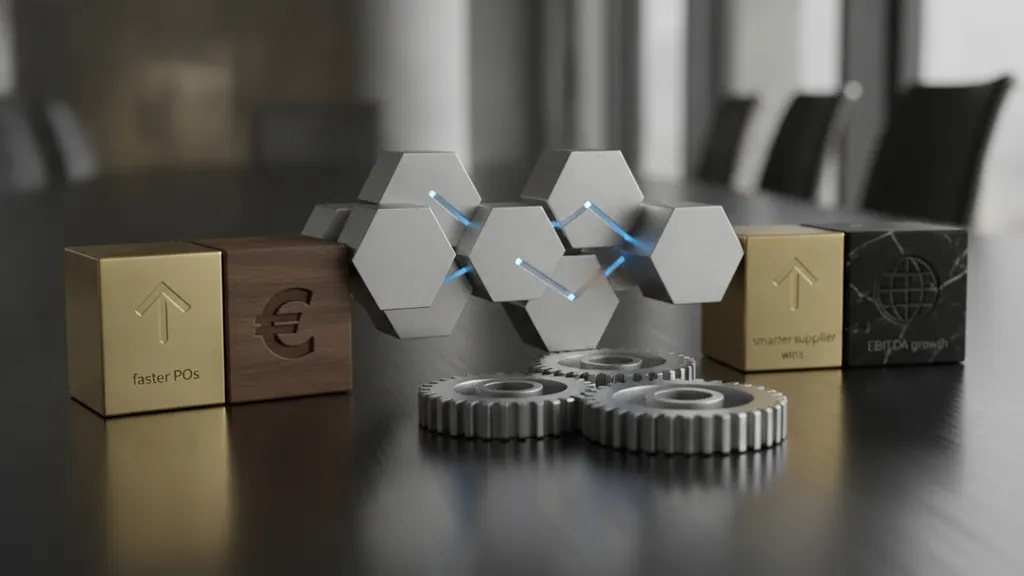
What AI-powered supplier onboarding looks like end to end
What took procurement teams three to five weeks on paper collapses to two to four business days when AI agents handle document extraction, sanctions screening, and risk scoring in sequence. Supplier activation ends with a valid W-9, insurance certificate, banking details, tax status, and initial risk score loaded in the ERP, with a human reviewing only the exceptions.
Step one is intake. An AI agent pulls the supplier data package, extracts fields from PDFs, cross-references business registries, and populates the vendor master record. Step two is verification: banking details are validated against sanctions lists and public filings via SEC EDGAR and OFAC feeds, insurance certificates are parsed for coverage limits, and tax status is confirmed against IRS TIN matching.
Step three is risk scoring. The model evaluates financial stability signals (public filings, credit reports, court records), operational signals (delivery performance from peer buyers where data-sharing agreements exist), and ESG signals. Step four is contract generation: the model drafts a supplier agreement from your standard template, red-lines any counter-proposals against your fallback positions, and routes to legal only when clauses fall outside pre-approved ranges. Our AI contract review automation guide shows how legal ops sits inside this loop.
In a 2024 engagement with a Midwest industrial components manufacturer running $140M in direct spend, the AiiACo team compressed supplier activation from 18 days to three by routing document extraction, sanctions screening, and risk scoring through a single AI agent, with a procurement analyst covering only the exception queue. Nemr built AiiACo's infrastructure-first deployment framework across engagements in industrial manufacturing, wholesale distribution, and financial services operations. The pattern that separates AI procurement automation programs that ship from ones that stall is architecture: point tools handle a step, while AI infrastructure owns the whole workflow with observability, human review queues, and rollback.

How AI demand forecasting reduces overstock and stockout risk
AI demand forecasting cuts forecast error by 20-50% and stockouts by 65% compared to classical statistical models, per McKinsey operations practice. For a distributor holding $60M in inventory, a 30% forecast error reduction typically frees $8-12M of working capital while lifting service levels, a return that compounds quarterly as the model ingests more signal.
Classical ARIMA and moving-average models handle steady demand well, but they fail when the world changes, which the world does routinely. AI demand forecasting models ingest many more signals: promotions, weather, macro indicators, competitor pricing, social listening, and shipping-lane congestion, and they update daily rather than monthly.
AI procurement automation lets the demand signal reach the buying signal in near real time, so replenishment orders adjust before shelves empty. The most productive architecture pairs a machine forecast with a human review layer. The AI produces a base forecast, an uncertainty band, and a plain-English explanation. Category planners review only SKUs where model confidence drops below a threshold, which cuts planner workload while raising accuracy. Gartner supply chain research at gartner.com shows human-in-the-loop forecasting outperforms full-auto and full-manual on both accuracy and adoption. In a 2025 rollout with a Southeast specialty chemicals distributor holding $60M in inventory, the AiiACo team dropped SKU-level forecast error from 38% to 22% inside two quarters and released roughly $9M of working capital by pairing an ensemble model with a category-planner review layer scoped to low-confidence SKUs. In a 2025 engagement with a Southeast regional food distributor managing 4,200 active SKUs, AiiACo's forecasting layer reduced forecast error from 31% to 18% across two quarters, with planners reviewing only the 190 SKUs where model confidence dropped below threshold.
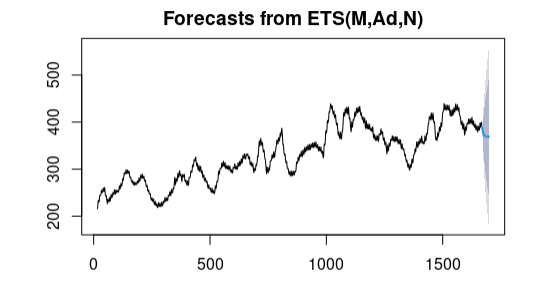
Integration, governance, and change management for production rollouts
Forrester research identifies master data readiness as the top ROI predictor for AI procurement automation programs, ahead of model selection and vendor choice. Three prerequisites must be true before go-live: data clean enough for the model to trust, an ERP integration layer, and a governance model that handles reviewed or reversed AI decisions. Miss one and you get a demo.
Integration begins with the ERP: SAP S/4HANA, Oracle Fusion, Netsuite, and Microsoft Dynamics all expose APIs sufficient for procurement flows. The heavier lift is master data. Duplicate vendors, inconsistent unit-of-measure codes, and out-of-date item taxonomy all break AI outputs. Budget four to eight weeks of data preparation before any model touches production.
Governance covers three surfaces. First, model risk: what training data was used, what the model can and cannot decide, and when a human must review. Second, audit trails: every AI decision needs a timestamped record with input features and confidence scores, which regulators, including under the EU AI Act, increasingly expect. Third, exception handling: which team owns each escalation path. Our vendor selection guide covers the 8 diligence questions to ask before picking an AI procurement automation partner, and our governance checklist covers the audit surface.
Change management is the piece programs quietly underinvest in. Buyers and category managers need to see the model as a colleague that hands them cleaner work, not a threat. That takes visible wins in the first 60 days: a supplier onboarding that used to take three weeks closing in three days, a category review that used to take a week landing in an afternoon.
AI procurement automation describes the application of machine learning models and AI agents to purchase-order processing, supplier onboarding, demand forecasting, and contract review. Traditional procure-to-pay platforms such as Coupa, SAP Ariba, and Ivalua are the system of record; the AI layer on top reads unstructured inputs, predicts risk, and handles judgment work at machine speed. The table below maps the practical differences across six dimensions.
| Dimension | Traditional procure-to-pay | AI procurement automation |
|---|---|---|
| Decision layer | Rule-based routing and human judgment on every transaction | Model-driven decisions with human review reserved for exceptions |
| PO cycle time | 3-5 business days on average | Hours; up to 80% faster per BCG benchmark data |
| Supplier risk scoring | Manual credit checks and periodic spot audits | Continuous, multi-signal scores updated daily against public filings and operational data |
| Demand signal frequency | Monthly statistical forecast from historical data | Daily ensemble model ingesting promotions, weather, macro indicators, and competitor signals |
| ROI source | Process efficiency and compliance enforcement | 5-10% material cost reduction, working capital release, and 65% fewer stockouts |
| Unstructured document handling | Manual data entry or rigid OCR templates | AI extraction from any document format with field-level confidence scores |
Frequently asked questions
How long does it take to deploy AI procurement automation in a mid-market manufacturer?
Realistic timelines run 90 to 180 days from kickoff to first live workflow. Variance depends on master data readiness, ERP integration complexity, and how many approvers touch each purchase order today. A clean SAP S/4HANA instance with a single approval matrix can land purchase-order automation in about 12 weeks. A fragmented multi-ERP environment with legacy vendors typically needs 20-24 weeks. Per BCG operations research, programs that spend the first 30 days on data preparation ship faster than programs that jump straight to model deployment.
Which procurement workflow should we automate first?
Start with purchase-order processing if your invoice volume exceeds 500 per month, or supplier onboarding if compliance review is the bottleneck. Both are high-volume, rule-driven, and rich in structured data, which lets the AI produce measurable ROI inside a single quarter. Demand forecasting is a natural second phase, once purchasing data flows cleanly and replenishment rules are loaded in the ERP. Deloitte procurement benchmarks find these three workflows carry 60-70% of total procurement automation ROI in the first year.
How much does AI procurement automation typically reduce direct material costs?
BCG benchmark data places the reduction range at 5-10% for companies that pair automated procurement with AI-supported supplier negotiation and category management. Gains come from three sources: better supplier selection driven by richer scoring, more competitive tenders driven by faster round-trip cycle times, and reduced maverick spend once catalogs and workflows are enforced. For a $400M manufacturer with $180M in direct spend, a 6% material cost reduction lands roughly $10.8M against EBITDA, before accounting for working capital released by tighter inventory.
Do we need a data science team to run this?
No, but you need someone who owns model performance and can escalate issues to the AI vendor. In practice, a strong procurement analyst working two days a week with the vendor is enough for a mid-market rollout. The vendor handles model training, monitoring, and retraining; your team owns business rules, exception queues, and change management. HBR research on AI adoption in operations finds internal ownership of governance beats internal ownership of the model as a predictor of program success.
How do we handle the EU AI Act and other AI governance rules?
Any AI system that impacts vendor selection, contract terms, or pricing likely qualifies as a limited-risk or high-risk system under the EU AI Act, depending on how autonomously it acts. The practical answer is threefold: keep humans in the loop on decisions above a materiality threshold; log every input, output, and confidence score for audit; document training data lineage so any challenged decision can be traced to its source. Gartner AI governance research walks through what regulators and enterprise buyers actually ask for during diligence.
What is the difference between AI procurement automation and traditional procure-to-pay software?
Traditional procure-to-pay software (Coupa, Ariba, Ivalua) is workflow software: it routes documents through approval chains and enforces rules. AI adds a decision layer: it reads unstructured supplier documents, predicts risk, suggests category assignments, negotiates within pre-approved ranges, and forecasts demand. Gartner spend management research finds the two are complementary. Companies with the highest returns run traditional procure-to-pay as the system of record and layer AI infrastructure on top to handle judgment work that previously sat with human buyers.