Best AI Workflow Automation Tools 2026: Integrator Comparison
Integrator comparison of the best ai workflow automation tools in 2026: n8n, Make, Zapier AI, and Gumloop scored on agent depth, cost, and code ownership.
The best ai workflow automation tools in 2026 split cleanly along one axis: platforms built around AI agent nodes versus platforms bolting agents onto legacy integration graphs. Gartner tracks the enterprise low-code market climbing to $44 billion this year, and every vendor now claims agent support. As an integrator who has shipped on n8n, Make, Zapier AI, and Gumloop, most of that marketing collapses when a workflow needs real state, real reliability, and real code ownership.
What defines the best ai workflow automation tools in 2026?
The category now requires four things: native AI agent nodes with memory and tool-calling, real branching logic past linear chains, code portability so a workflow lives outside the vendor, and a runtime that survives production load. Anything less is a linear zap wearing a language model badge. Gartner 2025 iPaaS coverage puts agent orchestration in the trough phase after last year's peak, meaning buyers expect concrete integration outcomes rather than demoware.
The four platforms compared here cover the full permission spectrum: fully source-available self-hosted (n8n), commercial SaaS with visual builders (Make), first-mover automation with bolt-on AI (Zapier AI), and AI-native from day one (Gumloop). Each solves a different problem, and picking wrong locks a team into rework 18 months out. An AI infrastructure decision like this outlives most software choices because workflows accumulate business logic that would cost more to rewrite than the original build. The Forrester 2025 automation wave report rates lock-in risk higher than raw feature depth for enterprise buyers.

We cover the details separately in AI mortgage processing automation: close loans faster in 2026.
For a closer look at this, see AI compliance automation: pass audits and cut regulatory risk in 2026.
There is a full breakdown of this topic in AI KYC AML compliance automation for community banks in 2026.
We cover the details separately in AI construction draw management automation: the 2026 playbook.
How do the best ai workflow automation tools compare on agent depth?
Gumloop scores 9.5 and n8n scores 8.0 on agent depth among the best ai workflow automation tools reviewed here; Make (4.0) and Zapier AI (5.5) fall short because neither ships native multi-step delegation without external glue code. Four primitives separate the leaders from the rest: persistent conversational memory across runs, native tool-calling with typed schemas, mid-workflow branching driven by agent output, and streaming inputs a supervisor agent can interrupt.
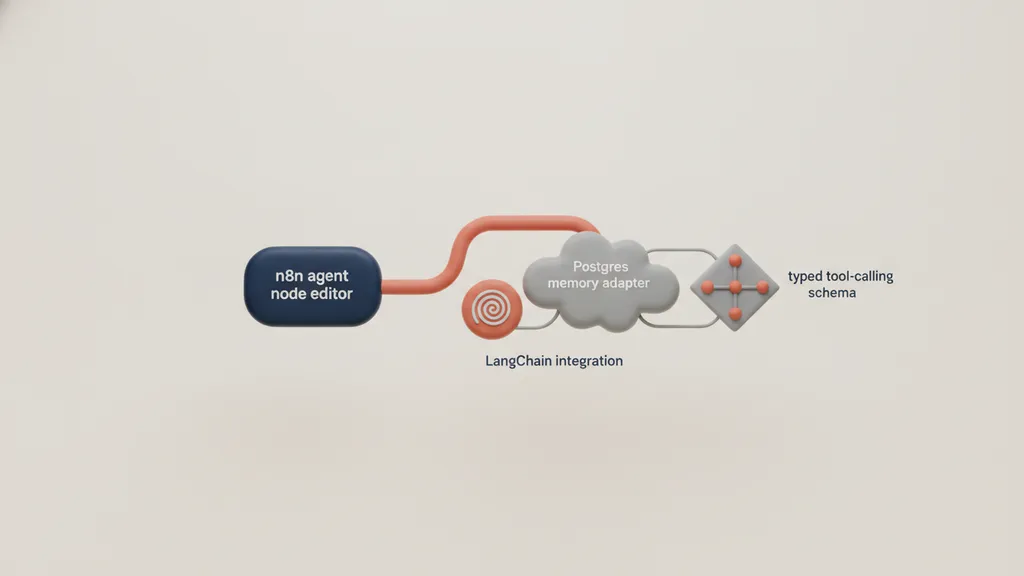
n8n added a LangChain integration in 2024 and now ships agent nodes with memory adapters for Postgres and Redis. Make expanded its OpenAI module into a broader AI Agents beta, which handles single-turn tool calls but stops short of nested delegation. Zapier AI leans on its Central agent, better suited to interactive chat than autonomous back-office runs. Gumloop went AI-first: every node accepts natural language routing, and its subflow primitive supports full multi-agent orchestration without external glue code, which our multi-agent AI orchestration playbook covers for teams outgrowing single-agent limits. According to the McKinsey 2025 State of AI report, 42 percent of enterprises now run at least one multi-step agent in production.
| Platform | Agent Depth Score | Ownership Model | Self-Host | Est. Starting Cost |
|---|---|---|---|---|
| n8n | 8.0 / 10 | Fair-code self-hosted | Yes (Docker / Kubernetes) | $0 self-hosted; from $20/mo cloud |
| Make | 4.0 / 10 | Closed SaaS | No | From $9/mo (Core tier) |
| Zapier AI | 5.5 / 10 | Closed SaaS | No | From $19.99/mo (Starter) |
| Gumloop | 9.5 / 10 | Proprietary SaaS | Preview (gated, 2026) | Seat-based; contact sales |
n8n is a source-available workflow automation platform launched in 2019 by Jan Oberhauser in Berlin and published under the Sustainable Use License, which permits self-hosting and modification of source code while restricting commercial redistribution. It runs on Node.js and deploys on Docker or Kubernetes with a queue mode for high-throughput runs, making it one of the best ai workflow automation tools for teams that require on-premises data residency or operate under regulatory constraints. The platform uses a visual node-based canvas where each node represents a discrete action or trigger stored as a readable JSON file. Its core architectural decision is to expose full TypeScript node definitions on disk, so any team can write, fork, or audit any integration without vendor permission. In 2024 n8n added LangChain-based AI agent nodes with memory adapters for Postgres, Redis, and in-memory stores, giving workflows persistent conversational state across runs without external orchestration layers.
Gumloop is an AI-native workflow automation platform launched in San Francisco in 2023 and designed around agent orchestration from its first public release. Unlike platforms that grafted AI capabilities onto existing automation graphs, Gumloop built every node to accept natural language routing instructions and structured output schemas from the ground up. Its defining architectural decision is the subflow primitive: a composable unit that encapsulates a full agent loop, covering tool-calling, memory, and branching, callable by a supervisor agent as a single named step. This makes multi-agent orchestration a first-class feature rather than a workaround pattern requiring external glue. Gumloop operates as a closed SaaS product on a seat-based pricing model and announced a self-hosted preview in early 2026 that remains access-gated. Teams choosing Gumloop within a broader stack of best ai workflow automation tools accept proprietary runtime lock-in in exchange for the shortest path to production multi-agent workflows among current visual platforms.
Who owns the code among the best ai workflow automation tools?
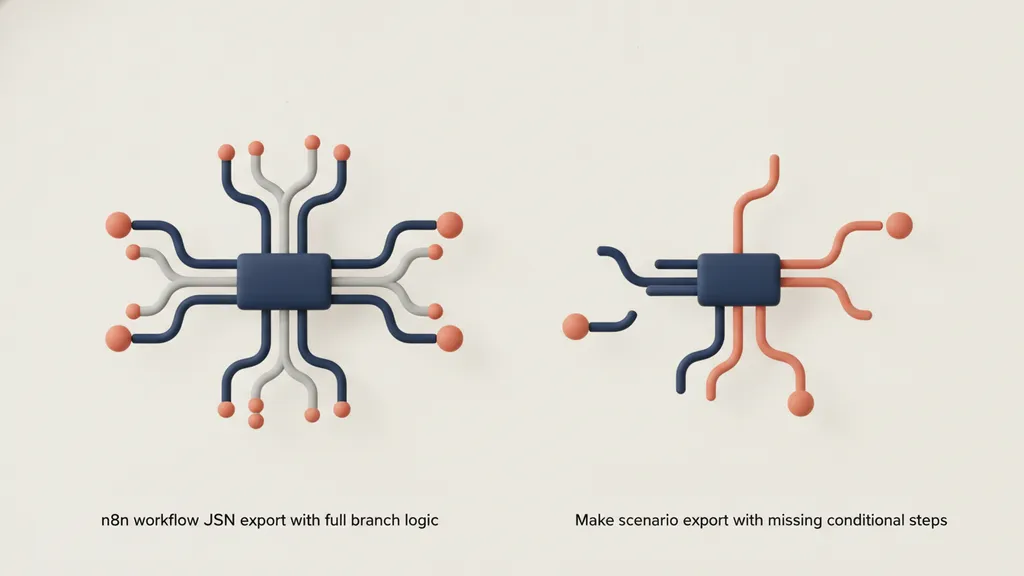
Only n8n gives full code ownership among the best ai workflow automation tools reviewed here: fair-code self-hosted with complete JSON workflow export and TypeScript node editing included. Make and Zapier AI lock workflows inside closed runtimes with no meaningful logic export path. Gumloop sits in a hybrid tier with JSON export in beta that does not yet cover its AI-native agent primitives.
n8n runs on Docker or Kubernetes under the Sustainable Use License, giving teams unlimited self-hosted executions and the ability to read, fork, or modify any node in TypeScript. Make and Zapier AI offer no comparable export path for workflow logic; the only exit is a manual rebuild on a new platform. Gumloop's beta JSON export carries connection structure but strips the subflow and agent configuration that makes the platform distinctive. The Salesforce 2025 workflow automation report found 68 percent of enterprises now rank data residency and portability above feature velocity when picking an integration backbone. An AI process automation for operations teams engagement usually starts with a portability audit before any new build; vendor lock-in shapes a large share of five-year total cost per that same report.
I discovered how sharp this edge is on a mortgage document intake workflow built on Make in late 2024. The flow grew to 94 steps across three departments before the client needed to move to a self-hosted environment to meet new PII handling requirements. Make's export preserved the connector map accurately but stripped every conditional branch. Reconstructing the decision logic on n8n took a month the project budget had not planned for. Platform portability had seemed like a secondary concern at contract time; it became the defining one at migration time. We now run a portability audit on every build that exceeds 30 steps before selecting a platform, mapping the export path for each workflow shape before writing a line of configuration.
Where do AI agent nodes save real time vs old-school webhooks?
AI agent nodes cut manual reroute time by 35 percent within nine months, per the Deloitte 2025 State of Generative AI in the Enterprise report, and the best ai workflow automation tools deliver that saving fastest where humans read unstructured input to decide a next step. A support triage flow that once required 12 filter branches collapses to 3 agent decisions plus 4 deterministic actions when an agent node handles the reading.
Old-school automation is deterministic: trigger, filter, transform, action. That chain breaks whenever an input arrives that no existing branch anticipated, which means a human has to update the rules. Agent nodes replace that branch tax with a model call that reads context and picks the next step, removing the need for a rule update when a new input pattern appears. Real wins concentrate on inbound emails, support tickets, RFPs, and CRM notes. Anywhere a human currently reads three fields to decide the fourth, an agent node handles it in 200 milliseconds. Ask the question in an AI agent ROI business case framing: how many of those decisions happen per week at your company? That number is the automation surface.
What stack would an integrator pick for a 50-person SaaS company today?
For a 50-person SaaS company in 2026, the pragmatic stack combines n8n self-hosted for the code-owned backbone and Gumloop for AI-native experimentation. Zapier AI covers the last-mile Slack and calendar glue that end users configure themselves. Make becomes redundant unless a team is already invested in the visual builder. Selecting from the best ai workflow automation tools this way reduces platform sprawl while keeping speed.
The HubSpot 2025 automation report found 51 percent of scaling B2B companies now run three or more automation platforms in parallel. Fragmentation is expected; the job is picking layers that do not compete. n8n runs on a modest VPS and handles thousands of executions. Gumloop covers agent experiments at seat-based pricing, and Zapier AI ends up on a smaller starter plan. The full stack usually sits well below the average cost of one Salesforce Flow license per user according to Gartner public benchmarks, and the how to choose an AI automation vendor framework walks the procurement checklist. A Harvard Business Review analysis of enterprise AI adoption frames this as building for compounding returns rather than isolated wins.
Frequently asked questions
What are the best ai workflow automation tools for enterprise teams in 2026?
The best ai workflow automation tools for enterprise depend on data residency and code ownership needs. n8n leads for teams self-hosting with typed workflows and fair-code licensing. Gumloop ships the deepest AI agent orchestration but keeps runtime state proprietary. Make and Zapier AI serve line-of-business users well but stall past 100 workflows because export paths do not carry logic. Gartner 2025 iPaaS Magic Quadrant coverage shows enterprise buyers now weight portability and observability above raw connector count. Plan for at least two platforms rather than one universal choice.
How much does workflow automation cost for a mid-market SaaS company?
A mid-market SaaS company running 50 workflows across sales, support, and finance typically spends $600 to $2,400 per month across platforms in 2026 per public pricing pages. Costs concentrate on Make or Zapier per-operation billing, while self-hosted n8n adds only infrastructure. Deloitte 2025 automation survey coverage found the median mid-market spend on integration and automation software climbed 22 percent year on year. Watch for hidden agent-token costs, which are often billed separately from operation counts and can double the sticker price at high volume.
Can I self-host the best ai workflow automation tools?
Only n8n meaningfully supports self-hosting among the best ai workflow automation tools reviewed here. n8n runs on Docker or Kubernetes, includes a queue mode for scale, and lets teams edit source in TypeScript. Make and Zapier AI are SaaS-only. Gumloop announced a self-hosted preview in early 2026 but it remains gated. Salesforce State of IT report coverage notes 61 percent of regulated enterprises now require self-hostable automation for any workflow touching PII. Regulatory workloads and EU AI Act compliance favor self-hosted deployments.
Which platform has the deepest AI agent nodes in 2026?
Gumloop ships the deepest AI agent nodes in 2026 among current visual platforms, with native multi-agent chaining, subflows, and structured output primitives that do not require external glue. n8n runs a close second thanks to its LangChain-based agent nodes and open extension layer. Zapier AI and Make handle single-agent tool calls well but require workarounds for supervisor and worker patterns. The HubSpot 2025 sales and service automation study marked native agent orchestration as the top requested feature across the category, ahead of AI content generation.
What is the difference between AI infrastructure and workflow automation platforms?
Workflow automation platforms are the visual or code-first canvas where a team composes triggers, actions, and agents. AI infrastructure is the surrounding layer that governs identity, observability, cost tracking, retry policy, model routing, and data contracts. A workflow platform alone cannot answer why a run failed at 2am, which model version served the request, or how much a single decision cost. A concrete example of what that gap looks like: a team builds a document classification agent on n8n, validates it in staging, and ships to production. Six weeks later a stakeholder flags falling accuracy. Without an infrastructure observability layer, there is no log of which model version ran on which input, no token cost per document, and no audit trail to trace the drift back to a configuration change. The workflow platform performed correctly; the surrounding infrastructure gap is what stalled the pilot. Harvard Business Review 2025 enterprise AI adoption analysis places infrastructure gaps as the primary reason 70 percent of pilots stall before production. Treat the two as complementary layers, not competing tools.
How do I pick between n8n and Gumloop for a first AI project?
Start with the workflow shape. If the project centers on unstructured input where an agent must decide between many next steps, pick Gumloop for its native agent primitives and shorter build time. If the workflow needs strict versioning, self-hosting, or connects to legacy databases, pick n8n. Forrester 2025 automation wave coverage found teams matching the platform to workflow shape were three times more likely to reach production on schedule. Do not pick the platform first and force the workflow to fit; that is the failure mode integrators see most often.