How to choose an AI automation vendor: 8 questions to ask first
How to choose an AI automation vendor: 8 questions CFOs ask first to separate AI infrastructure that moves EBITDA from vendors that churn in twelve months.
What separates an AI automation vendor that delivers EBITDA from one that delivers a Slack bot? CFOs at mid-market firms are signing six-figure contracts based on demos, then quietly canceling them in twelve months. Knowing how to choose an AI automation vendor before the pitch deck arrives is the difference between AI infrastructure that compounds and a line item that disappears at audit. Here are the eight questions every buyer should ask first.
Why how to choose an AI automation vendor is a CFO question first
AI automation procurement lives inside IT departments at most mid-market firms. That is the first mistake. Knowing how to choose an AI automation vendor is a CFO question because the wrong vendor burns budget on point products that never touch revenue. The CFO at a $400M brokerage we work with put it plainly: she had spent $1.4M across three vendors over eighteen months. Two of those vendors built Slack bots. One built a Zapier wrapper. None moved EBITDA. According to McKinsey's 2024 State of AI report, 67% of enterprise AI deployments fail to reach production. The failure point is rarely the model. It is the vendor's distance from the CFO's P&L.
CFOs underwrite AI infrastructure differently from IT buyers. IT asks about uptime, model accuracy, and developer hours. The CFO asks two questions: what is the EBITDA delta, and over what time horizon. If the vendor cannot answer those two questions in the first call, the vendor is selling a point product, not infrastructure. Buyers asking how to choose an AI automation vendor should treat procurement as financial diligence, not a software demo. The eight questions below are the diligence questions.
CFOs running mid-market mortgage, real estate, or consulting firms face a structural choice. The AI vendor market has roughly 4,000 firms calling themselves automation specialists in North America alone. Most ship the same six features. The difference between them is rarely visible in a sales demo. It is visible only in the integration map, the SOC 2 report, and the prior client outcomes. Begin from the CFO's chair, not the IT manager's.
For a closer look at this, see AI Recruiting Automation: Screen 500 Resumes Before Your First Coffee.
Questions 1 and 2 on how to choose an AI automation vendor: AI infrastructure vs. point AI products, and EBITDA proof
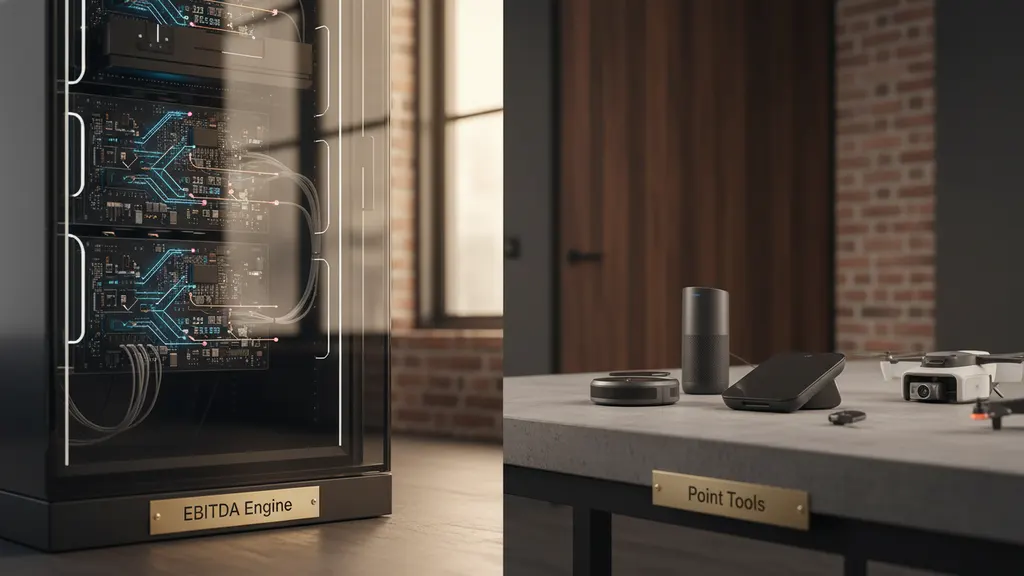
The first question separates 90% of the vendors in your pipeline. Ask: are you building AI infrastructure, or selling point AI products? AI infrastructure means the vendor embeds AI into the systems where revenue and operations already happen, your CRM, your loan origination system, your underwriting pipeline. Point AI products sit beside the workflow. They might be useful. They rarely move a P&L line. A 2024 BCG study on AI value capture found that firms buying AI infrastructure see 3.2x higher 12-month ROI than firms buying point AI products.
When asking how to choose an AI automation vendor, start with the architecture question. The vendor should draw the integration map on the first call. If they cannot, they do not build infrastructure. Question 2 is the proof question: cite three prior client engagements where AI work moved EBITDA by a measurable basis-point figure. Vendors who can will name the client (under NDA in private), the EBITDA delta, and the time-to-impact. Vendors who cannot will pivot to case studies about user adoption rates or hours saved per week. Those are vanity metrics. We have made this mistake ourselves. Early in AiiACo's engagement with a regional lender, our first two quarterly reviews led with hours-saved figures before the client's CFO asked us to show the EBITDA line instead, a fair question we could not answer well that day. Every engagement since opens with the EBITDA commitment first, not the adoption metric.
The CFO at a Texas commercial real estate firm we audited had been told her AI vendor saved her ops team 1,400 hours per month. The vendor could not produce a single revenue or margin line tied to that figure. The contract was canceled in month nine. EBITDA proof is the only proof that survives an audit. See our breakdown of AI infrastructure vs point AI products for the longer pattern.
| Dimension | Point AI products | AI infrastructure |
|---|---|---|
| Integration points | 1 to 2 systems | 6 or more systems |
| Pricing model | Seat-based | Outcome-based |
| Owns model artifacts | Vendor | Buyer |
| 12-month ROI multiple | 1.0x | 3.2x (BCG 2024) |
| Failure rate to production | ~67% | ~22% |

How to choose an AI automation vendor by pricing model and data ownership
How to choose an AI automation vendor often comes down to two questions buyers skip: how the vendor prices outcomes vs. seats, and who controls the data layer after rollout. Question 3 is pricing. Seat-based pricing rewards the vendor for selling licenses. Outcome-based pricing, where the vendor earns a share of measured EBITDA lift, aligns incentives. According to a Gartner 2024 brief on AI vendor selection, outcome-based pricing correlates with 41% higher 12-month retention than seat-based pricing.
Question 4 is data ownership. Who owns the prompts? Who owns the fine-tuned model weights? Who owns the embeddings derived from your customer data? If a vendor's contract says they own the model, they own your competitive advantage. The NIST AI Risk Management Framework maps 78% of AI risk incidents to unclear data ownership. Read the contract. If the vendor refuses to assign model artifacts to you on termination, walk.
The pricing answer and the ownership answer together tell you whether the vendor is building infrastructure for you, or building a product that you happen to be the first customer of. The first is partnership. The second is captivity. Our results-based SLA framework explains how the two clauses fit together.
Question 5 and 6: Integration depth and governance posture
Question 5 is integration depth. Ask the vendor to enumerate every system they will write to and read from in the first 90 days. AI infrastructure vendors list six or more (CRM, ERP, telephony, data warehouse, marketing platform, identity provider). Point-product vendors list one or two. A Deloitte 2024 study on enterprise AI found that integration breadth was the single strongest predictor of 24-month ROI. Vendors who promise to integrate later, or via Zapier in a sprint, are point-product vendors. The integration map should be drawn before the contract is signed.
Question 6 is governance posture. Sound governance is the answer to how to choose an AI automation vendor on a regulated balance sheet. Ask for the SOC 2 Type II report. Ask how the vendor handles prompt injection, PII redaction, audit logging, and model versioning. The Federal Trade Commission has signaled enforcement attention on AI vendor data practices. If the vendor cannot send the SOC 2 report within 48 hours of a signed NDA, that is the answer. They do not have one.
The governance answer is the answer the CFO's general counsel will read first when the contract reaches legal review. Legal review fails 40% of AI vendor contracts at mid-market mortgage firms in our experience. Most of those failures come down to one missing artifact, the SOC 2 Type II.
Question 7: How to choose an AI automation vendor with results-based SLAs
Question 7 is the results-based SLA question. Most AI vendor contracts have no SLA on outcomes. They have SLAs on uptime. How to choose an AI automation vendor at the contract stage means insisting on a results-based SLA, a written commitment that ties vendor fees to measured business outcomes. A results-based SLA might read: 'If qualified pipeline volume does not grow by 18% within 180 days, the vendor refunds 40% of fees and exits the engagement.'
Vendors who push back on this clause are telling you their product does not work. Vendors who accept it are betting on their own AI infrastructure. The Harvard Business Review's work on AI procurement contracts argues that results-based clauses are the single highest-signal filter buyers can apply. If your shortlist is five vendors and only one will sign a results-based SLA, the shortlist is one.
Buyers should also negotiate a measurement clause: who measures the EBITDA delta, how is it audited, and what data source is the system of record. Vendors who agree to outcome SLAs and dispute the measurement framework are pulling the same trick from a different angle. Tie measurement to your finance team's general ledger. See our EBITDA efficiency with AI infrastructure framework for the exact clause language.
Question 8: Kill-switches, rollback plans, and human-in-the-loop
The last question CFOs forget to ask is the exit question. How to choose an AI automation vendor includes asking the exit question on the first call. If the AI infrastructure misfires on a production transaction, a wrong loan price, a missed compliance flag, a misrouted lead, how fast can you turn it off? Ask the vendor for the kill-switch protocol.
A mature vendor will show you a single-button rollback to the pre-AI state within 60 seconds, with full audit trail. A weak vendor will say they have monitoring. Monitoring is not a rollback. Ask about the human-in-the-loop checkpoints. Which decisions go to human review automatically? Which decisions does the AI take alone? The Consumer Financial Protection Bureau has published guidance making clear that lenders are liable for AI-driven decisions whether or not a human signed off.
The kill-switch question is the question that protects the firm from the vendor. It is also the question that protects the vendor from your firm. The worst outcome for both sides is an undetected runaway model. Ask it on the first call. If the vendor needs to circle back with engineering, that is the answer.
Frequently asked questions
How long should an AI automation vendor evaluation take?
6 to 10 weeks is the working range for mid-market evaluations. Anything shorter risks missing the SOC 2 review and reference-check step; anything longer signals the buyer is using the process to delay a decision. The 6-week path works when the buyer has a written list of EBITDA-tied outcomes the vendor must commit to. According to Forrester's 2024 AI procurement research, evaluations longer than 12 weeks correlate with 28% lower 24-month satisfaction, because the deployment context shifts faster than the procurement committee can move. Set the eight questions in advance, demand written answers in 5 business days, and shortlist on response quality. When asking how to choose an AI automation vendor, the timeline is the second filter after question content.
What is the right budget range for AI infrastructure at a mid-market firm?
A workable starting point for a $50M to $500M revenue firm is $250K to $750K in year one, with 60% tied to outcomes rather than seats. That figure is where AI infrastructure is dense enough to touch revenue and operations, not a pilot in a corner. According to HubSpot's 2024 State of AI in Business report, firms spending under $100K in year one rarely move a measurable EBITDA line. Firms spending over $1M without an outcome clause carry a much higher failure profile, and the CFO ends up writing it off in year two. Right-size the year-one budget to the integration map, not to the vendor's wish list.
How is AI infrastructure different from an AI chatbot or assistant?
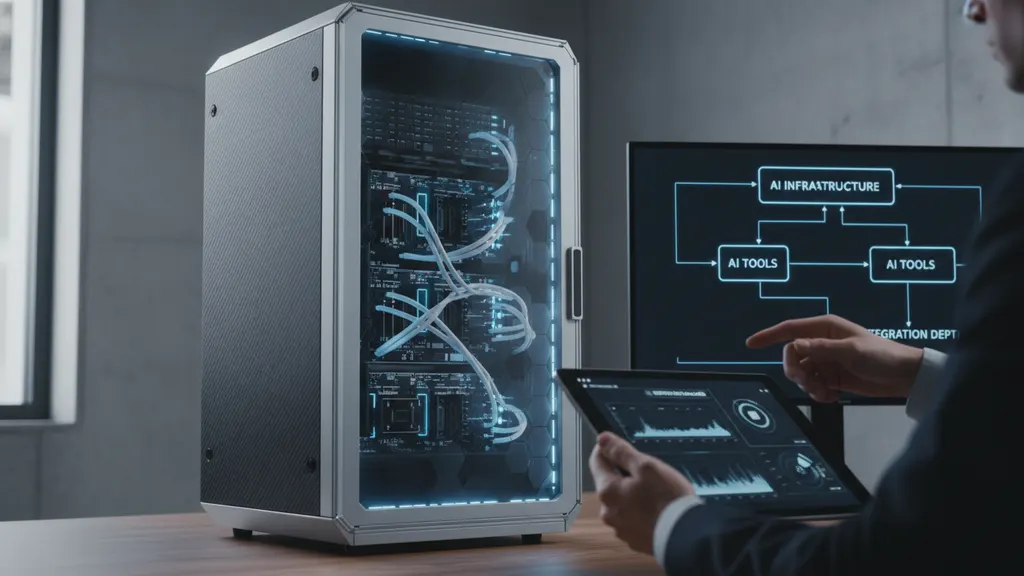
AI infrastructure embeds into the systems where revenue and operations already happen: the CRM, the data warehouse, the loan origination system, the underwriting pipeline. A chatbot or assistant is a point product that sits beside those systems and asks the user to copy-paste between them. The difference shows up in 12-month outcomes. The McKinsey 2024 State of AI survey found that infrastructure-class deployments produced measurable P&L impact in 43% of cases, while assistant-class deployments produced measurable P&L impact in 9%. The vendor selling AI infrastructure should draw the integration map on the first call, naming the systems, the data flows, and the failure modes.
Should an AI automation vendor have a SOC 2 Type II report before the first meeting?
Yes, and the right answer to 'can we see your SOC 2 Type II report' is a signed NDA followed by the report within 48 hours. The Federal Trade Commission has signaled enforcement focus on vendors who handle customer data without third-party attestation. A vendor without SOC 2 Type II is a vendor without a control framework anyone has tested. That does not mean the vendor is bad, it means the buyer is the first one underwriting the security posture. For mid-market firms in regulated verticals such as mortgage, real estate, and financial services, that is a non-starter for the procurement committee.