Multi-agent AI orchestration: run 10 agents without the chaos
Multi-agent AI orchestration: a working control plane for routing, memory, and observability across enterprise agent fleets of five or more in production.
How do you keep ten AI agents from talking over each other, repeating work, or quietly burning your runtime budget at 3 a.m.? The answer is not a better prompt or a smarter model. The answer is multi-agent AI orchestration: a control plane that routes tasks, isolates memory, and shuts down loops before they bleed cash. This piece is for operators running five or more agents in production, where every miscoordination shows up on the next finance review.
What multi-agent AI orchestration actually means
Multi-agent AI orchestration is the infrastructure layer that decides which agent handles which task, what memory each one can read or write, and how outputs reconcile before reaching a downstream system. McKinsey 2024 State of AI found that 72 percent of enterprise AI adopters have deployed multiple agents in production, but only 19 percent have a documented coordination layer. That 53-point gap defines the scale of the problem.
Most teams confuse orchestration with parallelization. Running five agents at once is not orchestration. It is concurrency. Orchestration adds the rules: which agent has authority over which artifact, what happens when two agents reach the same conclusion at different costs, how the system recovers when one agent times out mid-task. Without those rules, an agent fleet behaves like a meeting with no chair.
The distinction matters because AI infrastructure sits at a different abstraction level than the models themselves. A model can be swapped. The orchestrator stays. The 53 percent running without a documented coordination layer are treating concurrency as orchestration and will find out on their next monthly cost report.
We cover the details separately in AI for Real Estate Agents: A 2026 Playbook for Brokerage Operations.
Why agent fleets fail without multi-agent AI orchestration
Agent fleets fail in predictable ways once multi-agent AI orchestration is missing. The first failure is duplication: two agents independently picking up the same task because no router prevents it. The second is contradiction: outputs that conflict because no shared memory enforces consistency. The third is silent runtime cost growth that finance only sees on the monthly bill.
Duplication is the cheapest failure to detect. Bills go up. Logs show the same task ID processed by three agents. The team adds idempotency keys and moves on. The harder failure is contradiction. Picture a fleet handling mortgage underwriting: a document agent extracts the borrower stated income at $145,000. A verification agent pulls a tax transcript and computes $138,400. A risk agent scores against $145,000 because no one told it which number wins. The deal closes against the wrong base. By the time the post-mortem surfaces this, the loan is already on the books.
Contradiction is what Harvard Business Review 2024 analysis on managing generative AI risk called the dominant failure mode in production agent systems: not hallucination, but reconciliation. Agents do their jobs correctly in isolation and produce contradictory outputs together. The orchestration layer is where you resolve those conflicts before they propagate into customer-facing systems.

The control plane: routing, memory, observability
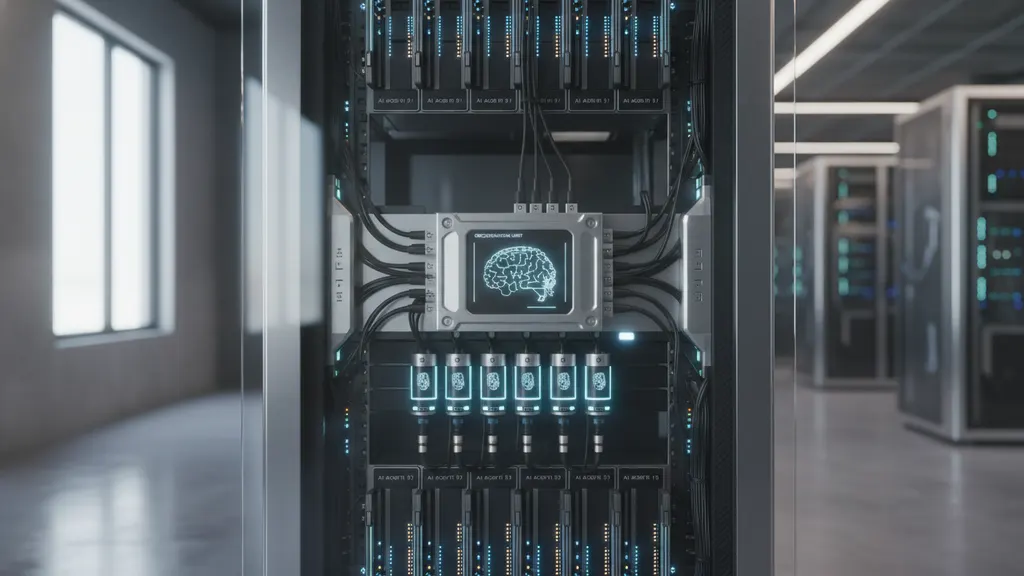
A control plane for multi-agent AI orchestration sits between the model layer and the business systems it touches. Its job is to decide who runs what, what state they share, and what to do when something goes sideways. Four layers handle these jobs: a router, a shared memory store, an audit log, and a circuit breaker.
The router is a classifier. It reads each incoming task and decides which specialized agent owns it. Bad routers send every task to every agent and hope the right one wins. Good routers cost less than a sub-cent per decision and route correctly 95 percent of the time on production traffic. Most teams underbuild here because routing feels boring. Then they look at their monthly token bill and find that 40 percent of spend went to wrong-agent retries.
Shared memory is where state lives across agents. A working pattern: a namespaced key-value store where each agent has read access to a common project context and write access only to its own outputs. Cross-writes get rejected at the storage layer. Conflicts trigger a reconciliation step before downstream writes. The implementation detail most teams skip is versioning. Every write to shared memory should carry a version stamp and the ID of the agent that created it. When a downstream agent reads a value, it records which version it consumed. That audit trail is what lets you roll back contaminated state without replaying the entire workflow from scratch. Without version stamps, a single bad write propagates silently to every agent that reads after it, and cleanup requires a full replay of all decisions made since the corruption entered the store. On a ten-agent fleet running several hours, that replay can cost more than the original task.
Observability is the layer everyone skips and regrets. Gartner 2024 forecast on agentic AI reports that 60 percent of agent projects without trace-level observability get rolled back inside 18 months. The reason is mundane: when something breaks at 4 a.m., you need to see which agent made which decision with which inputs.
Architecture patterns for multi-agent AI orchestration in production
Three architecture patterns dominate production multi-agent AI orchestration: hub-and-spoke, mesh with shared memory, and supervisor-with-workers. Each pattern has a sweet spot. Hub-and-spoke works under ten agents with simple coordination. Mesh handles complex peer-to-peer interactions at the cost of higher latency. Supervisor-with-workers is what most enterprises end up running.
Hub-and-spoke is the simplest pattern. A central orchestrator owns task routing, memory writes, and conflict resolution. Every agent talks to the hub, never to other agents. The advantage is observability. The disadvantage is the hub becomes a bottleneck past about 15 concurrent agents.
Mesh patterns let agents call each other directly. They scale further but make debugging worse. We rarely recommend mesh for finance-adjacent workflows. The traceability cost shows up the first time a regulator asks why a decision was made and your team cannot reconstruct the call graph.
We learned this at cost in Q3 2024, working with a mid-market insurance carrier building a ten-agent underwriting fleet. We chose a mesh pattern because each agent's output formed a direct input to two or three peers, and the dependency graph felt like it justified the architecture. Six weeks into production, a cross-write between the document extraction agent and the risk scoring agent loaded an incorrect income figure into shared state. There were no version stamps, so there was no clean rollback. Two engineers spent four days manually replaying three days of underwriting decisions. We rebuilt the fleet in supervisor-with-workers in Q4 2024, with the supervisor owning all state reconciliation and cross-writes rejected at the storage layer. Mesh was the right answer given our initial dependency reading. It was the wrong answer once we understood what finance-adjacent traceability actually demands.
Supervisor-with-workers splits the difference. A supervisor agent owns task decomposition and final approval. Workers handle independent sub-tasks. The supervisor reconciles. BCG 2024 generative AI value report found this pattern in 64 percent of enterprise multi-agent deployments that delivered measurable EBITDA gains in the first two quarters of operation.
Pattern choice should follow the work, not the other way around. Read the workflow you are trying to AI-enable, count the decision points, and pick the simplest pattern that covers them. See our analysis of AI infrastructure versus AI tools for the architectural distinction in detail.
Failure modes that only appear past five agents
Past five agents in production, multi-agent AI orchestration enters a regime where new failure modes appear that did not exist at smaller scale. The most common is memory pollution. Less common but more expensive is the recursive loop, where agent A asks agent B for input, and B reformulates and asks A back until the budget caps out.
Memory pollution happens when one agent writes incorrect context into shared memory and downstream agents inherit it. Without versioning, the bad context spreads. With versioning, you can roll back the affected tasks. Most teams discover this the first time a single bad document upload contaminates an hour of decisions across five agents and the cleanup takes a full day.
Recursive loops are funnier in retrospect. Two agents discover they each accept the other output as authoritative. They start passing the same artifact back and forth, each adding small refinements, until the orchestrator times out or the token budget hits its cap. Deloitte 2024 State of Generative AI in the Enterprise noted this pattern in 14 percent of surveyed production multi-agent deployments. The fix is explicit termination conditions and per-task token caps enforced at the orchestrator, not at the model layer. Model-layer generation limits stop a single response from running long, but they do not prevent the loop from being re-entered on the next dispatch call. Orchestrator-level caps check whether a task ID has already consumed its budget before routing the next agent call, which breaks the cycle at the routing layer rather than downstream where the damage compounds. Our guide to controlling LLM runtime cost covers the budgeting side in detail.
Measuring EBITDA impact on multi-agent AI orchestration
The right way to measure multi-agent AI orchestration is at the EBITDA line, not the model benchmark. Benchmarks tell you how a model performs on synthetic tasks. EBITDA tells you whether the orchestrated system makes the business cheaper to run, faster to operate, or measurably better at converting opportunities into closed revenue.
Three numbers track this monthly: cost per completed task, fully-automated task percentage, and time from request to result. Hold those three steady and the financial impact compounds in a way the finance team can audit. Drift on any one and the orchestrator is degrading.
| Metric | Single-agent baseline | Orchestrated fleet target |
|---|---|---|
| Cost per completed task | $0.42 | $0.18 |
| Fully-automated rate | 54% | 82% |
| Median time to result | 9.4 min | 2.1 min |
Cost per completed task includes failed retries, conflict resolutions, and human-in-the-loop interventions. Most teams measure happy-path cost and miss the long tail. The long tail is where 35 percent of spend lives once an agent fleet is past five agents.
The pattern that holds across our enterprise clients: a working orchestrator drives cost per task down 30 to 40 percent in the first quarter, then plateaus until the next architecture revision. Forrester 2025 AI predictions projected this same trajectory across mid-market multi-agent deployments. We covered the governance side in our piece on enterprise AI governance frameworks.
Frequently asked questions
How is multi-agent AI orchestration different from running multiple chatbots?
A chatbot pool answers questions in parallel. Multi-agent AI orchestration coordinates specialized agents toward a single outcome, with shared state, conflict resolution, and a routing layer that prevents duplicate work. The difference shows up in cost and quality. Gartner 2024 reported that 60 percent of agent projects without orchestration get rolled back within 18 months because their token spend and error rates make them uneconomic. Orchestrated fleets reuse memory across tasks, retry only failed sub-steps, and surface conflicts before they propagate downstream into invoices, contracts, or customer-facing messages where the cost of a wrong answer compounds.
What is the minimum team size to operate a multi-agent fleet?
One platform engineer plus one operator, if you keep agent count under six and route everything through a single orchestrator. McKinsey 2024 State of AI found that mid-market firms running production agent systems averaged 2.4 dedicated engineers per fleet, with another 1.8 part-time analysts handling prompt iteration and evaluation. Past ten agents you need a dedicated observability engineer because failure debugging without traces becomes impossible. The pattern repeats across our enterprise clients: teams that try to ship a five-agent system with one engineer end up firefighting weekly instead of shipping new business capability.
When should I move from a single agent to a multi-agent architecture?
When the single agent prompt has grown past 2,000 tokens of instructions and you are still missing edge cases. Harvard Business Review 2024 flagged that single-agent systems hit a complexity ceiling once they own more than three distinct skill domains. Past that point, every new instruction interferes with previous ones, and quality drops on tasks the agent used to handle correctly. Splitting into specialized agents with a router restores per-task performance. Multi-agent AI orchestration becomes the cost of admission once you cross that ceiling, not an optional upgrade you can defer for a future quarter.
How do I measure ROI on orchestration infrastructure?
Track three numbers monthly: cost per completed task, percentage of tasks that finished without human intervention, and time from request to result. BCG 2024 generative AI value reporting found that orchestrated multi-agent systems posted 38 percent lower cost per task than single-agent equivalents at the same quality bar, with payback periods averaging seven weeks for mid-market deployments. The trap is measuring orchestration ROI in isolation. The value shows up in the agent fleet economics, not in the orchestration layer itself. Build your dashboard around fleet-level unit cost and completion rate, then attribute back.